
Free SMART Goals Template (Printable PDF)
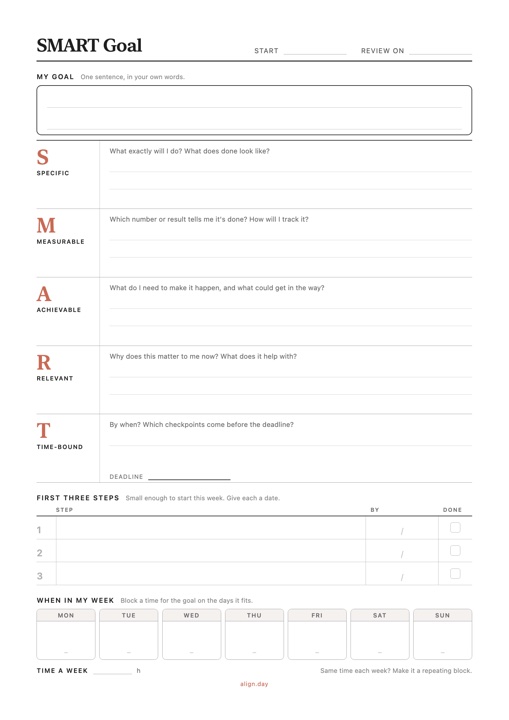
A SMART goals template with one goal on one page: the five SMART prompts, the first three steps with a date for each, and a row of day boxes to give the goal its time in your week. Free download, no signup.
PDF 1 page · A4, prints on Letter
Download SMART Goals Template PDF →What's included
- A Start and a Review on date at the top, and a My goal box for the goal in one sentence
- Five SMART rows, each with its letter, a question and lines to answer: Specific, Measurable, Achievable, Relevant and Time-bound, with a Deadline line
- First three steps, each with a By date and a Done box
- When in my week: seven day boxes, Monday to Sunday, to write the time you'll spend on the goal, and a Time a week total
- One A4 page that prints on US Letter, in light, ink-friendly gray
Why a goal setting worksheet needs a week row
Most goal setting templates stop at the deadline. The goal is written down, it's clear, and nothing in the week changes. The last two parts of this sheet close that gap: three first steps you can start this week, and the days and times the goal gets. A goal with hours in the week is a plan, not a wish.
That week row is the difference from the weekly planner, which plans a whole week of tasks. This page plans one goal, and the week row is only for its time.
How to write a SMART goal
- Write the goal in one sentence in the My goal box, the way you'd say it out loud.
- Answer the five prompts. Specific: what exactly, and what does done look like. Measurable: the number that tells you. Achievable: what you need and what could get in the way. Relevant: why now. Time-bound: the deadline and a checkpoint or two.
- List the first three steps. Make them small enough to start this week, and give each a date.
- Block the time. In the day boxes, write a time on the days the goal fits. Add up the hours. If the total looks too big for your week, the goal isn't achievable yet: change the goal or the deadline.
- Review on the date at the top. Tick the steps you did, write the next three, and keep the week row if it worked.
Example: a goal on the SMART goals template
Start: Jan 5 · Review on: Feb 2
My goal: Hold a ten-minute conversation in Spanish by June.
| Row | What's written |
|---|---|
| S Specific | Talk with my colleague Lucía for ten minutes in Spanish without switching to English. |
| M Measurable | Ten minutes by the clock. Track lessons done and 30 new words a week in a notebook. |
| A Achievable | Needs a course book and a weekly partner. In the way: late nights cost the morning lessons. |
| R Relevant | Half my team speaks Spanish, and we're visiting Mexico in July. |
| T Time-bound | Checkpoints: a two-minute chat by Feb 15, five minutes by Apr 1. Deadline: June 1 |
First three steps
| # | Step | By | Done |
|---|---|---|---|
| 1 | Buy a beginner course book | Jan 6 | ☐ |
| 2 | Ask Lucía for a weekly 15-minute chat | Jan 8 | ☐ |
| 3 | Finish unit 1 | Jan 12 | ☐ |
When in my week
| Mon | Tue | Wed | Thu | Fri | Sat | Sun |
|---|---|---|---|---|---|---|
| 7:00–7:30 | 7:00–7:30 | 7:00–7:30 | 10:00–11:00 |
Time a week: 2.5 h
Two and a half hours fits the week, so the goal stays as it is. Three short mornings keep the lessons going, and the longer Saturday hour is for practice out loud.
In Align, the times in that row can be recurring time blocks on your day's timeline, so the goal has its hours every week.

